







API 602 SW End Forged Stainless Steel F304 Extended Stem Cryogenic Globe Valve with Drip Tray
Product Details
Introduction of API 602 SW End Forged Stainless Steel F304 Extended Stem Cryogenic Globe Valve with Drip Tray
|
Cryogenic applications impose demanding requirements on valve materials, sealing systems, stem design, manufacturing accuracy, and operational safety. Fluids such as liquid nitrogen, liquid oxygen, liquid argon, liquefied natural gas (LNG), and other low-temperature media can operate at temperatures far below conventional industrial service conditions. Ordinary valves may experience material embrittlement, seal contraction, excessive frost formation, or operational difficulties if they are not specifically designed for cryogenic service. This valve is based on the compact forged-valve philosophy associated with API 602, which covers gate, globe, and check valves in sizes up to DN 100 (NPS 4) for petroleum and natural gas applications. The current API 602 edition covers pressure classes 150, 300, 600, 800, and 1500, with socket-welding and threaded ends addressed for applicable smaller sizes and pressure classes. For cryogenic service, however, API 602 should be considered together with the applicable cryogenic design, material, testing, and purchaser requirements. Depending on the project specification, standards such as BS 6364, ASME B16.34, ASME B16.11, and applicable inspection and testing requirements may also be specified. The BOPIN valve configuration described here is intended to provide reliable isolation, compact installation, strong pressure containment, and improved operator protection in cryogenic piping systems. |
 |
Product Overview
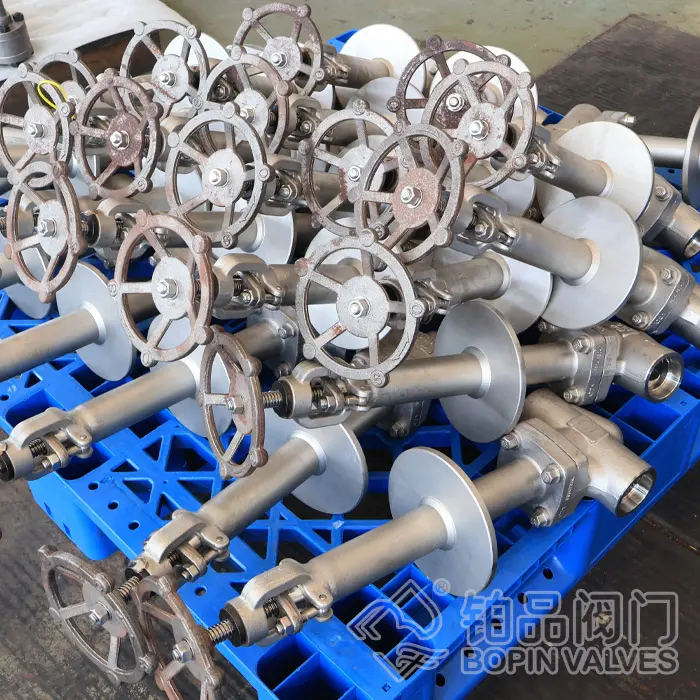
The valve is a forged stainless steel globe valve with socket-weld ends. Its principal configuration can include:
- Design standard: API 602
- Valve type: Cryogenic globe valve
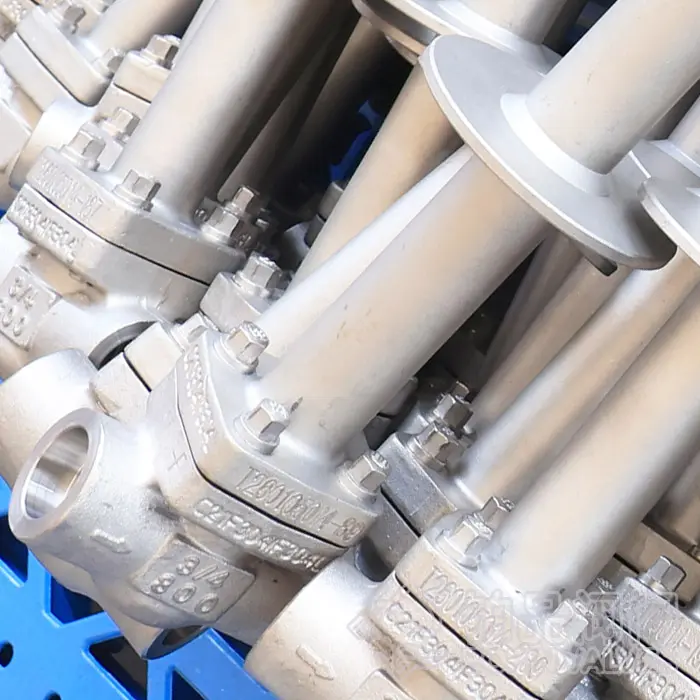
- Body construction: Forged
- Body material: ASTM A182 F304 stainless steel
- End connection: Socket weld (SW)
- Stem: Extended stem design
- Bonnet: Extended cryogenic bonnet
- Operation: Manual handwheel
- Flow-control element: Globe-valve disc
- Sealing: Low-temperature-compatible packing and gasket system
- Drip tray: Integrated or fitted around the extended bonnet/stem area
- Service: Cryogenic and low-temperature fluids
- Pressure class: According to project specification, commonly selected from applicable API 602 classes
- Size: Selected according to pipeline requirements
- Testing: According to applicable API/project cryogenic testing requirements
API 602 specifically recognizes socket-welding ends for applicable compact valve sizes, with socket-weld dimensions associated with ASME B16.11.
The exact pressure-temperature rating, size range, material grade, trim, bonnet construction, stem extension length, packing arrangement, and cryogenic test requirements should always be confirmed against the project datasheet.
Forged F304 Stainless Steel Body
 |
One of the most important features of this cryogenic API 602 Flange End Compact Steel Globe Valve is its forged stainless steel body. ASTM A182 F304 is an austenitic stainless steel forging grade commonly used for pressure-containing valve components. Its combination of corrosion resistance, toughness, strength, and fabricability makes it suitable for many demanding industrial applications. For cryogenic valves, material behavior at low temperature is particularly important. A valve body must retain adequate mechanical integrity and toughness while exposed to severe temperature reduction. Austenitic stainless steels are widely selected for cryogenic applications because they maintain favorable low-temperature properties compared with many ferritic or carbon-steel alternatives. The forged construction also offers advantages in compact high-pressure valve manufacturing. Instead of relying on a large cast body, forging produces a pressure-containing component formed from wrought material. Proper forging, heat treatment, machining, and inspection contribute to dimensional consistency and structural reliability. The body can be machined to accommodate the globe valve seat, disc, stem passage, bonnet connection, and socket-weld ends. Critical sealing surfaces require accurate machining and controlled surface finish. |
For F304 valves, material traceability is also important. A professional manufacturing process should maintain heat numbers, material certificates, inspection records, and relevant dimensional documentation throughout production.
API 602 Design Philosophy
API 602 is widely associated with compact forged steel valves used in petroleum and natural gas service. The standard covers gate, globe, and check valves in sizes from DN 8 through DN 100, corresponding to NPS 1/4 through NPS 4, and includes several pressure classes.
For globe valves, API 602 provides a framework for compact construction, pressure-containing components, materials, end connections, inspection, and testing.
The socket-weld configuration is particularly useful where a compact welded connection is preferred. API 602 references ASME B16.11 for socket-weld ends.
A cryogenic globe valve based on API 602 therefore combines two important design objectives:
- Compact forged valve construction
- Specialized low-temperature design
It is important to distinguish these functions. API 602 establishes the valve's applicable compact industrial design requirements, while cryogenic service introduces additional requirements for low-temperature materials, extended bonnet geometry, packing, testing, cleaning, and operational safety.
Socket-Weld End Connection
The SW end is designed for permanent welded installation into a compatible piping system.
In a socket-weld connection, the pipe is inserted into the valve socket and welded around the outside. This provides a compact connection without the external flange dimensions associated with flanged valves.
The advantages of the SW configuration include:
Compact Installation
Socket-weld valves require less installation space than flanged valves. This is particularly useful in cryogenic skids, gas distribution systems, LNG equipment, laboratory systems, and compact process units.
Reduced Connection Weight
Eliminating separate flanges, bolts, nuts, and gaskets can reduce connection weight and simplify the overall piping arrangement.
Reliable Permanent Joint
When the valve and piping materials, welding procedure, joint preparation, and welding quality are properly controlled, a socket-weld connection can provide a robust permanent connection.
Suitable for Small-Bore Piping
API 602 specifically addresses socket-welding connections for applicable smaller valve sizes.
During installation, the socket-weld joint must be prepared according to the applicable piping and welding specification. Welding procedures should account for the stainless steel material and the requirements of cryogenic service.
Extended Stem and Cryogenic Bonnet
The extended stem is one of the defining characteristics of a cryogenic globe valve.
In conventional industrial valves, the packing and stem operating components are located relatively close to the cold valve body. In cryogenic service, allowing extremely cold fluid or vapor to reach the packing area can create several problems.
The extended bonnet creates a longer thermal path between the cold fluid region and the stem packing area.
This arrangement helps:
- Reduce direct heat transfer to the packing
- Keep the packing at a comparatively warmer temperature
- Reduce excessive frost formation around the packing
- Maintain better sealing conditions
- Improve handwheel accessibility
- Protect operating components from extreme cold
- Reduce the possibility of ice accumulation interfering with operation
The exact extension length should be selected according to the valve size, service temperature, insulation arrangement, operating environment, and project specification.
An extended bonnet should not simply be regarded as a longer stem. The entire bonnet, stem, packing, thermal arrangement, and internal geometry should be designed as an integrated cryogenic system.
Why an Extended Stem Is Important
 |
Cryogenic liquids can cause extremely rapid heat transfer when they enter a valve body. The surrounding metal can become very cold, and atmospheric moisture can freeze on exposed surfaces. If the packing region becomes excessively cold, the packing material may contract or lose its optimal sealing characteristics. Frost can also accumulate around the stem. By placing the packing farther away from the cold zone, the extended bonnet helps establish a thermal gradient. The valve therefore has two functional zones: Cold zone: Warm zone: This separation is fundamental to cryogenic valve design. |
Drip Tray Design
|
The drip tray is another useful feature for a cryogenic globe valve installed in an environment where condensation or frost can accumulate. When a cryogenic valve operates below ambient temperature, atmospheric moisture may condense and freeze on external surfaces. During temperature changes, defrosting or melting can generate liquid water. A properly designed drip tray provides a controlled area for collecting such condensate and directing it away from sensitive equipment or surrounding components. The drip tray can help:
The drip tray should be regarded as an external moisture-management feature rather than a pressure-containing part of the valve. |
 |
Its dimensions, material, mounting arrangement, drainage orientation, and connection should be determined according to the specific valve design and installation environment.
Globe Valve Flow-Control Principle
Unlike a gate valve, which is primarily intended for isolation, a globe valve uses a movable disc to regulate flow through a shaped seat passage.
When the handwheel is rotated, the stem moves the disc toward or away from the seat.
Valve Open
When the disc moves away from the seat, the flow passage opens and cryogenic fluid can pass through the valve.
Valve Closed
When the disc moves downward onto the seat, the passage closes and the valve isolates the downstream section.
Throttling
The globe-valve configuration can provide controlled flow adjustment. However, prolonged throttling of cryogenic fluids should only be performed when the valve design and project specification permit it. Excessive throttling can generate high local velocity, pressure drop, vibration, noise, and potentially undesirable flashing or cavitation effects depending on the fluid and pressure conditions.
For this reason, the valve should be selected primarily according to its intended service duty rather than assuming that every globe valve is suitable for continuous throttling.
Stainless Steel F304 Trim
The trim configuration should be selected according to the cryogenic medium, pressure, temperature, corrosion requirements, and purchaser specification.
A stainless steel F304 valve may use compatible stainless steel materials for components such as the stem and disc. Some valve designs use different grades or hardfaced seating materials depending on pressure, wear, and service requirements.
The stem must have adequate mechanical strength to transmit handwheel torque while maintaining dimensional stability at low temperature.
The disc and seat must provide reliable shut-off without excessive friction.
The seat surface should be precisely machined and inspected because even small defects can compromise sealing performance.
For cryogenic service, the manufacturer should also consider differential thermal contraction between mating components.
Packing System
Packing is one of the most critical areas of a globe valve because the stem must move while maintaining pressure containment.
For cryogenic applications, the packing system should be selected specifically for low-temperature service rather than simply using a standard industrial packing arrangement.
A typical cryogenic packing arrangement may incorporate materials and configurations suitable for the specified temperature range.
The extended bonnet assists the packing by moving it away from the coldest region.
The packing gland should be properly adjusted to achieve sealing without creating excessive stem friction.
Too little compression can result in leakage.
Too much compression can increase operating torque and interfere with smooth stem movement.
Therefore, controlled packing installation and gland adjustment are important parts of valve assembly.
Seat and Disc Sealing
The sealing system determines the globe valve's ability to isolate the process line.
During manufacturing, the seat and disc sealing surfaces should be machined to precise dimensions and checked for surface defects.
The sealing surfaces should be clean and free from scratches, dents, foreign particles, or machining debris.
Cryogenic valve sealing is particularly demanding because components can contract when cooled.
A valve that seals correctly at ambient temperature must also be designed and tested for its specified cryogenic operating conditions.
This is why cryogenic testing is an important consideration when purchasing a valve for LNG, liquid nitrogen, oxygen, argon, or other low-temperature services.
Pressure Classes
API 602 covers compact valves in pressure classes including 150, 300, 600, 800, and 1500.
The appropriate class should be selected according to:
- Design pressure
- Operating pressure
- Design temperature
- Fluid properties
- Piping specification
- Applicable pressure-temperature rating
- Required safety margin
- Applicable project standards
Class 800 and Class 1500 configurations are commonly associated with compact socket-weld and threaded valve applications under API 602.
The valve's actual allowable working pressure at cryogenic temperature must not be inferred solely from the nominal pressure class. The manufacturer and purchaser should verify the complete pressure-temperature rating and applicable material requirements.
Cryogenic Applications
The API 602 SW End Forged Stainless Steel F304 Extended Stem Cryogenic Globe Valve can be considered for applications such as:
LNG Systems
Liquefied natural gas facilities require valves capable of operating at extremely low temperatures. Cryogenic globe valves can be used for isolation and flow-control duties in LNG-related piping and equipment.
Air Separation Plants
Air separation units process oxygen, nitrogen, and argon at cryogenic temperatures. Stainless steel cryogenic valves are widely used in associated piping and equipment.
Liquid Nitrogen Systems
Liquid nitrogen is commonly used in industrial cooling, laboratories, food processing, electronics, pharmaceutical manufacturing, and other applications.
Liquid Oxygen Systems
Liquid oxygen applications require strict material compatibility, cleanliness, and safety controls. Valve configuration and cleaning requirements should be established according to the applicable oxygen-service specification.
Liquid Argon Systems
Liquid argon storage and distribution systems require components designed for low-temperature service.
Cryogenic Storage Tanks
Extended-stem globe valves can be used around cryogenic storage tanks where the operating mechanism needs to remain accessible while the valve body is exposed to low-temperature fluid.
Gasification Systems
Cryogenic liquids are often converted back to gaseous form through vaporization systems. Valves may be installed on liquid and gas-side piping according to process requirements.
Advantages of the Forged Construction
The forged body provides several potential advantages.
High Structural Integrity
A properly manufactured forging can provide strong pressure-containing construction suitable for compact high-pressure valves.
Compact Geometry
Forged bodies can be manufactured with efficient wall thickness and compact dimensions.
Suitable for High-Pressure Service
The forged configuration is particularly useful for small-bore valves operating at elevated pressure.
Consistent Machining
Forged valve bodies can be precisely machined for seats, bores, bonnet connections, and welding ends.
Material Traceability
Forged stainless steel valve components can be supplied with heat identification and material certification according to project requirements.
Advantages of Stainless Steel F304
F304 offers several useful properties for cryogenic valve construction:
- Austenitic stainless steel structure
- Good corrosion resistance
- Good fabricability
- Good low-temperature toughness characteristics
- Suitable for many cryogenic environments
- Good resistance to atmospheric corrosion
- Long service potential when properly selected and maintained
However, F304 should not automatically be considered suitable for every cryogenic fluid. Fluid compatibility, temperature, pressure, oxygen cleanliness, corrosion conditions, and project specifications must be evaluated before final material selection.
Manufacturing Process
A high-quality API 602 cryogenic globe valve should undergo a controlled manufacturing process.
1. Raw Material Selection
Certified ASTM A182 F304 stainless steel forging material is selected according to the approved material specification.
2. Forging
The body is produced through a controlled forging process.
3. Heat Treatment
The forged body receives the specified heat treatment to achieve the required metallurgical and mechanical properties.
4. Machining
CNC and precision machining are used to create:
- Flow passage
- Seat area
- Bonnet connection
- Stem bore
- Socket-weld ends
- External mounting surfaces
5. Seat Machining
The seat is precisely machined to ensure accurate disc contact.
6. Extended Bonnet Manufacturing
The extended bonnet and stem arrangement are manufactured to the specified dimensions.
7. Drip Tray Fabrication
The drip tray is produced and fitted according to the approved design.
8. Cleaning
Cryogenic valves may require specialized cleaning to remove oil, grease, particles, and manufacturing contaminants.
9. Assembly
The body, disc, stem, bonnet, packing, gland, handwheel, and other components are assembled under controlled conditions.
10. Inspection and Testing
The completed valve undergoes dimensional, pressure, functional, and applicable cryogenic testing.
Inspection and Testing
API 602 includes requirements related to inspection and testing.
For a cryogenic globe valve, testing should be established according to the applicable valve standard, project specification, and service requirements.
Typical inspection activities may include:
- Visual inspection
- Material verification
- Dimensional inspection
- Socket-weld dimensional inspection
- Body pressure testing
- Seat leakage testing
- Stem operation testing
- Packing leakage inspection
- Cryogenic performance testing where specified
- Cleanliness inspection
- Identification and marking inspection
API 598 is commonly referenced for inspection and testing of forged globe valves, while ASME B16.11 is used for socket-weld-end dimensions.
For cryogenic applications, additional low-temperature testing may be required to verify sealing performance and operational behavior under representative service conditions.
Cryogenic Testing
Cryogenic testing is particularly valuable when the valve will operate under severe low-temperature conditions.
During a cryogenic test, the valve is cooled to a specified temperature using an appropriate cryogenic medium or controlled test system.
The test can evaluate:
- External leakage
- Seat leakage
- Packing performance
- Stem operation
- Thermal contraction
- Functional reliability
- Pressure retention
Testing conditions should be defined by the purchaser's specification and applicable cryogenic standard.
A successful ambient-temperature pressure test alone does not necessarily demonstrate complete suitability for cryogenic operation.
Cleaning Requirements
Cleanliness is especially important for cryogenic valves.
Manufacturing oils, grease, metal chips, dust, welding residues, and other contaminants can negatively affect valve performance.
For oxygen-related applications, cleanliness requirements can be particularly stringent because hydrocarbon contamination can create serious safety hazards.
A suitable cleaning procedure may include:
- Degreasing
- Solvent cleaning
- Particle removal
- Drying
- Visual inspection
- Clean-room or controlled-area assembly where required
- Protective packaging
The exact procedure should follow the applicable service specification.
Installation Considerations
Correct installation is essential for reliable valve performance.
Before installation, verify:
- Valve size
- Pressure class
- Flow direction
- Material
- Socket-weld dimensions
- Operating temperature
- Valve orientation
- Stem extension length
- Drip tray position
- Cleanliness
- Piping alignment
The pipe should be properly aligned with the valve before welding.
Excessive piping stress should not be transferred to the valve body.
During welding, appropriate procedures should be used to avoid overheating or damaging internal valve components.
The valve should also be protected against welding spatter and contamination.
Insulation Considerations
Cryogenic valves are frequently installed with insulation systems, but the extended bonnet and packing region must remain appropriately configured.
The insulation arrangement should not interfere with:
- Handwheel operation
- Stem movement
- Packing inspection
- Drip tray function
- Drainage
- Maintenance access
The valve's extended bonnet is intended to maintain separation between the cold body and upper operating components. Incorrect insulation can interfere with this thermal design.
The final insulation arrangement should therefore follow the equipment manufacturer's recommendations and project engineering requirements.
Maintenance
Although cryogenic globe valves are designed for demanding service, periodic inspection remains important.
Maintenance personnel should inspect:
- Packing area
- Stem surface
- Handwheel
- Bonnet
- Drip tray
- Welded connections
- External frost patterns
- Signs of leakage
- Abnormal operating torque
If excessive frost appears around the packing or upper bonnet, the cause should be investigated rather than simply removing the frost repeatedly.
Possible causes may include:
- Abnormal heat transfer
- Packing leakage
- Damaged packing
- Incorrect insulation
- Valve damage
- Improper operating conditions
Any maintenance procedure must follow the plant's cryogenic safety procedures.
Safety in Cryogenic Service
Cryogenic fluids can cause severe cold burns and frostbite. Rapid vaporization can also produce large quantities of gas and may create oxygen-deficient or oxygen-enriched environments depending on the medium.
Therefore, operators should not directly touch a cold valve surface without appropriate protection.
Safety considerations include:
- Wear appropriate cryogenic PPE
- Avoid direct contact with cold surfaces
- Ensure adequate ventilation
- Follow oxygen-service requirements where applicable
- Control ignition sources when required
- Verify pressure is relieved before maintenance
- Never disassemble a pressurized valve
- Follow plant lockout/tagout procedures
- Maintain safe access around the extended stem and drip tray
The drip tray improves condensate management but does not replace the need for proper plant drainage and safety procedures.
Why Choose an SW Cryogenic Globe Valve?
The combination of socket-weld ends, forged F304 stainless steel construction, extended stem design, and drip tray makes this valve particularly attractive for compact cryogenic piping systems.
Compact Design
The SW connection minimizes external dimensions and is suitable for small-bore piping.
Strong Forged Body
The forged F304 body provides a robust pressure-containing structure.
Cryogenic Extended Stem
The extended stem separates the packing and operating mechanism from the cold valve body.
Improved Condensation Management
The drip tray provides a practical method for collecting condensation and frost-related moisture.
Stainless Steel Construction
F304 stainless steel provides corrosion resistance and favorable low-temperature characteristics for many applications.
Manual Operation
The handwheel allows direct local operation without requiring external power or instrumentation.
Industry-Recognized Design Basis
API 602 provides a recognized design framework for compact gate, globe, and check valves used in petroleum and natural gas industries.
Selection Guide
When selecting an API 602 cryogenic globe valve, purchasers should provide the manufacturer with complete service information.
Important parameters include:
1. Valve Size
Specify NPS or DN.
2. Pressure Class
Select the appropriate API/ASME pressure class.
3. Minimum Design Temperature
The lowest operating or design temperature is essential for material and sealing selection.
4. Medium
Identify whether the valve handles LNG, LIN, LOX, LAR, gaseous nitrogen, natural gas, or another medium.
5. Body Material
F304, F304L, F316, F316L, or another material should be selected according to service requirements.
6. End Connection
Confirm socket-weld dimensions and piping compatibility.
7. Extended Stem Length
The required extension depends on temperature, insulation, installation configuration, and accessibility.
8. Drip Tray
Specify whether a drip tray is required and define the preferred arrangement.
9. Testing
State whether cryogenic testing, oxygen cleaning, fugitive-emission testing, or other special testing is required.
10. Documentation
Specify material certificates, inspection reports, pressure test reports, cryogenic test reports, drawings, and certificates required for the project.
API 602 Cryogenic Globe Valve vs. Conventional Globe Valve
A conventional globe valve may be suitable for ordinary process applications, but cryogenic service requires additional design consideration.
|
Feature |
Conventional Globe Valve |
Cryogenic Globe Valve |
|
Body |
Standard industrial material |
Low-temperature-compatible material |
|
Stem |
Standard length |
Extended stem |
|
Bonnet |
Conventional |
Extended cryogenic bonnet |
|
Packing location |
Near body |
Positioned away from cold zone |
|
External frost |
Not a primary design consideration |
Specifically considered |
|
Drip management |
Usually unnecessary |
Drip tray may be provided |
|
Cleaning |
Standard |
May require specialized cleaning |
|
Testing |
Standard pressure testing |
Cryogenic testing may be required |
|
Service |
General process fluids |
Cryogenic fluids and low-temperature gas |
The exact design should always be determined by the operating conditions rather than by product name alone.
Quality Assurance
For industrial valve applications, quality assurance should cover the entire manufacturing process.
BOPIN can establish quality controls covering:
- Raw material inspection
- Forging inspection
- Heat-treatment records
- Chemical composition verification
- Mechanical property verification
- Dimensional inspection
- Machining inspection
- Seat inspection
- Assembly inspection
- Pressure testing
- Functional testing
- Cryogenic testing when specified
- Cleaning inspection
- Marking verification
- Final visual inspection
- Packaging inspection
Each valve can be identified with appropriate product information, including size, pressure class, material, standard, heat number, and other required markings.
Packaging for Export
Cryogenic valves require careful packaging because contamination must be prevented after final cleaning and testing.
A typical export packaging process may include:
- Final cleaning
- Drying
- Protective sealing of valve ends
- Protection of the stem and handwheel
- Protection of the socket-weld ends
- Drip tray protection
- Individual wrapping where required
- Placement into suitable cartons, plywood cases, or crates
- Internal shock protection
- External marking and identification
For oxygen-service valves, packaging should follow the applicable cleanliness requirements and purchaser specifications.
The API 602 SW End Forged Stainless Steel F304 Extended Stem Cryogenic Globe Valve with Drip Tray is a specialized valve solution for demanding low-temperature and cryogenic piping systems.
Its forged F304 stainless steel body provides a compact and robust pressure-containing structure, while the socket-weld connection offers an efficient permanent connection for compatible small-bore piping. The extended stem and bonnet separate the operating and packing area from the cold valve body, helping improve operational accessibility and sealing performance under cryogenic conditions.
The drip tray adds another practical feature by collecting condensation and moisture associated with extremely cold external surfaces.
API 602 provides the underlying compact forged-valve design framework and covers applicable sizes, pressure classes, socket-weld connections, materials, and inspection requirements. For a complete cryogenic valve specification, however, API 602 should be supplemented by the applicable cryogenic-service requirements, material specifications, testing procedures, cleanliness requirements, and project standards.
With the correct F304 material, extended bonnet geometry, cryogenic packing, precision-machined seating surfaces, properly manufactured SW ends, suitable drip-tray configuration, and verified testing, this valve can provide a dependable solution for LNG, air-separation, liquid nitrogen, liquid argon, liquid oxygen, cryogenic storage, and other specialized low-temperature applications.
For final selection, the purchaser should provide the required size, pressure class, minimum temperature, medium, socket-weld specification, stem extension length, trim material, drip-tray requirements, testing requirements, and cleanliness specification. These parameters ensure that the finished valve is matched correctly to the actual cryogenic service rather than relying only on its nominal API 602 designation.